Why most personalisation in hospitality is a habit problem, not a prediction problem — and where AI actually belongs
Boards keep asking what hospitality is doing about AI. The stock answer — predict what guests want — misunderstands the problem. Preference is already known; the opportunity is intervening in habits with rules you can own.
Every operator we speak to is being asked the same question by their board: what are we doing about AI?
It's a fair question, and the honest answer in our sector is more interesting than the one usually given. The stock answer runs something like: use AI to personalise the customer journey, so that on a cold morning we surface a hot drink. That isn't wrong. It also isn't AI, and it isn't personalisation. It's an if-statement with a weather feed.
The reason that answer keeps getting given is that the industry has borrowed a mental model from a different problem. It's worth understanding why the model doesn't transfer, because once you see it, the genuinely valuable applications become much easier to identify.
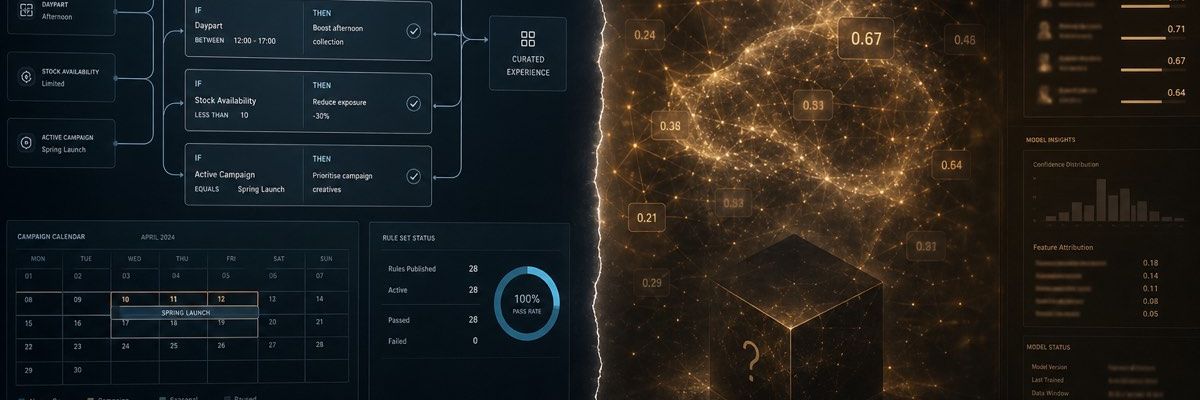
The recommendation engine is the wrong shape
Streaming and retail recommendation engines exist to solve a discovery problem. A platform holds tens of thousands of titles or millions of products. It has almost no idea what any individual customer wants. The catalogue is far larger than anyone can browse, preference is latent, and the whole commercial value of the system lies in inferring something the platform does not know.
Hospitality is the inverse on every axis.
Your menu has perhaps forty items, most customers can see all of them, and the customer's preference is not latent at all. It is written down in their transaction history, repeated with remarkable consistency, and often unchanged for years. Ask any barista about their regulars. They don't need a model.
So the information problem that justifies a recommendation engine barely exists here. There is very little to discover. Building a model to predict what a known customer will order is solving a problem you don't have, at the cost of a system nobody in your organisation can interrogate.
That leads to the useful reframe.
Personalisation is about deviation, not prediction
If preference is already known, the commercial opportunity isn't guessing it. It's deciding when and how to interrupt it. In practice, operators want one of three things:
- Shift a habit: Move a customer from their default to something with better margin, better stock position, or better satisfaction. The barrier isn't knowing their default. It's knowing what they'd accept instead, and at what moment they're open to being asked.
- Recover a fading customer: Their frequency is dropping. The trigger is behavioural, not preferential, and the required intervention is usually a reason to return rather than a different product.
- Increase attach: Get the pastry alongside the coffee. Timing, placement and framing do nearly all the work here.
None of those are prediction problems. All three are interventions in a pattern you can already see. And interventions have a property that predictions don't: someone has to own them.
Determinism is a feature you sell to the brand team
This is the part that gets missed when personalisation is discussed as a purely technical question.
Merchandising decisions in hospitality sit against real commercial constraints. Margin varies by line. Stock varies by store and by hour. Supplier commitments exist. Seasonal campaigns are signed off weeks in advance, sometimes with co-funding attached. Someone in the business is accountable for what appears on that screen.
A system that can't explain why it promoted something can't be owned by that person. When a model surfaces an almond croissant to a customer who has never bought one, on a day when the campaign calendar says flat whites, there is no satisfying answer to "why did we do that." And when it works, there's no transferable lesson either.
This is an organisational constraint, not a technological limitation, which is exactly why it tends to get argued away. It shouldn't be. Auditability is what makes personalisation something a brand team can adopt rather than tolerate.
Put the intelligence in the loop that writes the rules
The architecture that follows is straightforward, and it separates cleanly into three layers.
Analysis. Interrogate the transaction and loyalty data to find the patterns worth acting on. Which customers are drifting. Which substitutions actually get accepted. Which combinations are underexploited at which dayparts. This is genuinely hard analytical work, it operates on messy and high-dimensional data, and it is where modern models are useful.
Execution. Deterministic rules, running live in the journey, firing content based on the conditions present for that customer. Loyalty tier, recent purchases, daypart, store, channel. Fast, auditable, instantly changeable by the brand team, and entirely explainable after the fact.
Measurement. Test variants, measure incremental uplift rather than raw conversion, retire what doesn't work and tune what does. This is the layer that compounds, and it is the layer most personalisation programmes skip entirely.
The principle underneath it: put the intelligence in the loop that decides what rules to write, not in the loop that runs at the customer. The live journey has hard constraints — latency, brand accountability, allergen and pricing accuracy, regulatory exposure on profiling. The analysis loop has none of those. It can be slow, exploratory and wrong, because a human reviews the output before anything reaches a screen.
To the customer, the two architectures are indistinguishable. To the operator, one is a system you can run and the other is a system you host.
Where AI is unambiguously the right tool
None of this is an argument that AI has a small role in ordering. It has a large one. It just isn't in the merchandising layer.
The test is simple: is the input structured data, or is it language?
When the input is a customer record, a timestamp, a stock level or a temperature, a rule expresses the decision better than a model does. When the input is human language — speech, free text, messy intent — there is no rule to write, and this is where models do something that was genuinely impossible five years ago.
- Voice ordering: A customer speaking an order, with modifiers, in a noisy environment, in an accent. Drive-thru and telephone ordering both fall here. This is the most operationally significant AI application in our sector, because it addresses a labour line rather than a conversion percentage.
- Customer service: Handling and resolving inbound customer contact, most of which is a small number of repeated situations expressed in an unlimited number of ways. Classification and drafting are reliable today; bounded auto-resolution is close behind.
- Unstructured feedback: Turning free-text reviews and comments into themes per store, weekly, at a granularity no human team has time to reach.
Each of these takes language as input and produces something a rule could never produce. That's the signature of a real application.
Two questions worth asking
When an AI proposal reaches your desk, two questions separate substance from theatre.
First: is the input language, or is it structured data? If it's structured data, ask why a rule wouldn't be better — faster, cheaper, auditable, and owned by someone in your business.
Second: if this gets it wrong, who has to explain why? If the answer is nobody can, the architecture is wrong regardless of how well it performs in a demo.
Neither question requires a data science team to answer. Both will save you a great deal of money.
LineTen builds ordering and menu infrastructure for hospitality brands across the UK, Europe, North America, APAC and the Middle East. If you're working through where AI fits in your ordering estate, we're happy to have the conversation.